Peer Reviewer Process
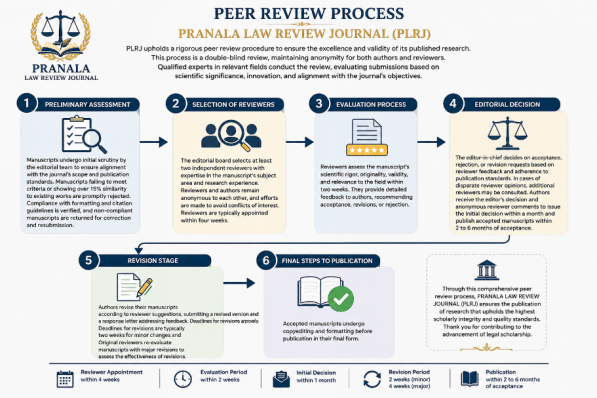
PRANALA LAW REVIEW JOURNAL (PLRJ) upholds a rigorous peer-review process to ensure the quality, validity, originality, and scholarly integrity of published research. The journal applies a double-blind peer-review system, in which the identities of both authors and reviewers remain anonymous throughout the review process. Qualified experts in relevant fields evaluate submitted manuscripts based on their scientific significance, originality, methodological rigor, relevance, and alignment with the journal's objectives.
Preliminary Assessment
All submitted manuscripts undergo an initial assessment by the editorial team to determine their alignment with the journal's focus and scope and to verify compliance with the journal's publication standards. Manuscripts that fail to meet the required criteria or demonstrate a similarity level of more than 15% with existing works may be rejected at this stage. The editorial team also verifies compliance with formatting, structure, and citation requirements. Manuscripts that do not meet these requirements may be returned to the authors for correction and resubmission.
Selection of Reviewers
The editorial board assigns at least two independent reviewers with relevant expertise and research experience in the subject area of the submitted manuscript. The identities of authors and reviewers are kept confidential throughout the review process. The editorial team also takes appropriate measures to avoid potential conflicts of interest. Reviewers are typically appointed within four weeks of the initial editorial assessment.
Evaluation Process
Reviewers evaluate manuscripts based on their scientific rigor, originality, validity, methodological quality, relevance, and contribution to the field. The review process is normally completed within two weeks. Reviewers provide constructive and detailed comments to assist authors in improving their manuscripts and recommend one of the following editorial outcomes: acceptance, revision, or rejection.
Editorial Decision
The Editor-in-Chief makes the final editorial decision regarding acceptance, rejection, or revision based on the reviewers' recommendations and the journal's publication standards. In cases where reviewers provide substantially different recommendations, the editorial team may appoint an additional reviewer to provide an independent assessment.
Authors receive the editorial decision together with the relevant anonymous reviewer comments. The initial editorial decision is normally communicated within one month. Accepted manuscripts are scheduled for publication according to the journal's publication workflow and may be published within 2 to 6 months after acceptance, depending on the completion of the editorial and production processes.
Revision Stage
Authors are required to revise their manuscripts in accordance with the reviewers' comments and editorial recommendations. A revised manuscript must be accompanied by a response letter explaining how each reviewer comment has been addressed.
The revision period is generally two weeks for minor revisions and four weeks for major revisions. Manuscripts requiring major revisions may be returned to the original reviewers for further evaluation to determine whether the revisions adequately address the issues raised during the review process.
Final Steps to Publication
Once a manuscript has received final acceptance, it proceeds to the production stage. The accepted manuscript undergoes copyediting, proofreading, formatting, and final preparation before being published in its final form.
Through this comprehensive peer-review process, PRANALA LAW REVIEW JOURNAL (PLRJ) is committed to maintaining high standards of scholarly integrity, academic quality, originality, and relevance in all published research.
Submission Preparation Checklist
All submissions must meet the following requirements.
- This submission meets the requirements outlined in the Author Guidelines.
- This submission has not been previously published, nor is it before another journal for consideration.
- All references have been checked for accuracy and completeness.
- All tables and figures have been numbered and labeled.
- Permission has been obtained to publish all photos, datasets and other material provided with this submission.